


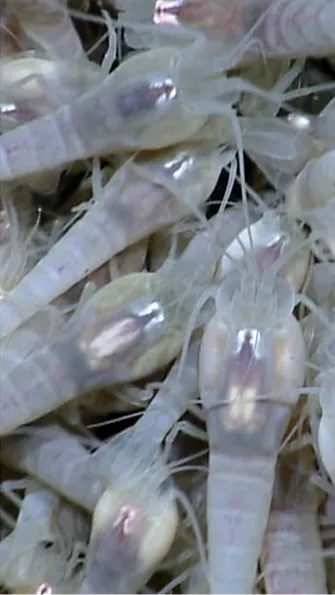
Some deep-sea shrimp, believed to be blind, travel great distances to reach their home — a boiling hot abyss at the bottom of the ocean with zero sunlight that's to most other life.
Marine scientist Heather Bracken-Grissom — along with Tamara Frank, professor at Nova Southeastern University, Sönke Johnsen, full professor at Duke University, and Jon Cohen, associate professor at the University of Delaware — hopes to uncover the secrets of these strange shrimp.
With a $1.35 million National Science Foundation (NSF) grant, the team will use advanced technology. It's a case of descending to the crushing pressure of the sea floor where the shrimp live.
Then, could you investigate them and their environment? Alvinocaridid ten-footed shrimp, or vent shrimp, swarm to the ocean’s thermal vents.
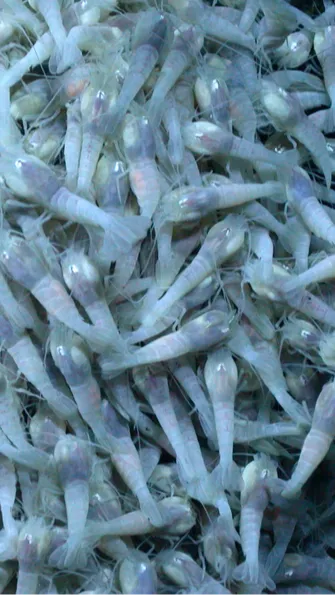
Some species of vent shrimp crowd together in the thousands on the sides of these vents, forming patches of ghostly white. It’s the equivalent of living on the side of a volcano. But vent shrimp aren’t aren'there. As larvae, they can live 300 to 3,000 feet away from the hydrothermal vents.
"There's a lot of mysteries surrounding these shrimps, like how do they even find the vents,” Bracken-Grissom said.
"Is vision involved in the detection over short distances, and once there, how are they so successful? We'll hopefully be able to answer some of these questions."
When vent shrimp were first discovered in the 1980s, it's been thought they were blind.
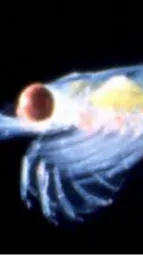
The current team is still determining. Previous vent shrimp were collected under the bright lights of a submersible, probably too harsh for the shrimps' sensitive eyes, rendering them blind.
So first, the researchers will examine the visual systems of the vent shrimp to determine if they are blind or not. Then, they want to understand if the fused eyes sense light to locate the vents.
"I've been wanting to work on these shrimp ever since I read the papers from 30 years ago that suggested they had non-functional eyes," said Frank, the lead PI at Nova Southeastern University. "I just can't understand how they could undergo such a massive metamorphosis from stalked juvenile eyes to huge dorsal adult eyes to produce a non-functional eye."
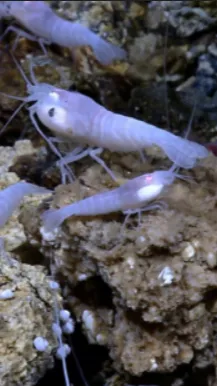
Researchers will rely on a remote-operated vehicle (ROV) that can be controlled from the ship to reach the vents and explore the shrimp and bioluminescence.
Essentially a giant robot, the ROV will collect samples and high-resolution video, using unique methods the team has developed over the decades to gather deep-sea species without blinding them."
“This is a lifelong dream of mine to study these habitats. Since I was in grad school and learned about these weird, blind shrimp at the vents, I wanted to study the,” Bracken-Grissom said.
“Now, here I am, all these years later — and I’m actually going to do i."
This is notes